
Knowing the limitations and versatility of the Drum set
Welcome back!
Welcome to my blog, where I’m on a mission to explore the art of drum set notation using notation software, particularly Musescore 4. Over the course of the next eight weeks, I’ll be diving into the vast potential of drum set music, from writing basic rock measure grooves to more complex rock grooves, and eventually different styles.
This week, we’re exploring common writing pitfalls in drum set notation and learning about the concept of how many limbs a player has and how they perceive drum set notation. We’ll discuss what makes it easier and more legible to read for players, and how to avoid writing things that are not comfortable or feasible to play. Get ready for some exciting drum set notation concepts!
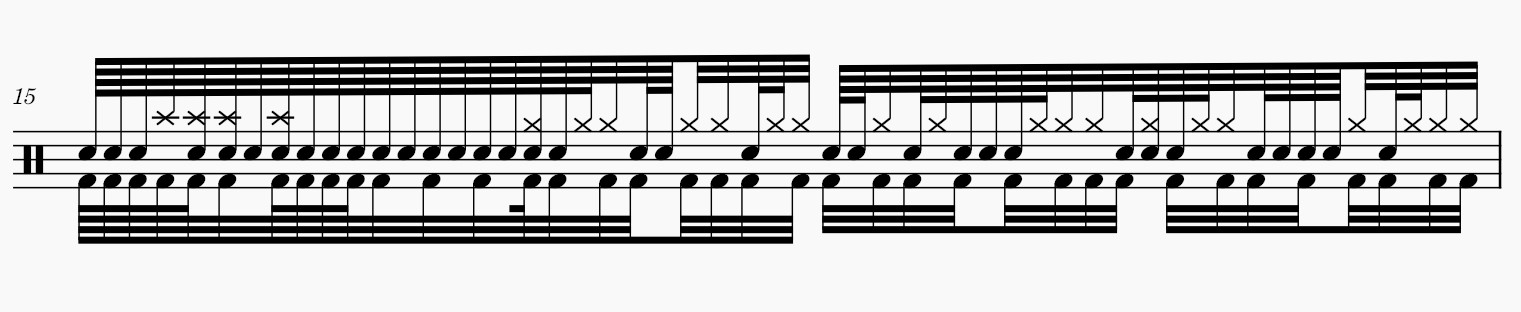
What's wrong with this picture?
Looking at the image above, I have to say it’s probably one of the most ridiculous things I’ve ever written in my drum set journey so far. It’s pretty obvious that it might be on the impossible-to-play side of things. However, what’s interesting about this picture is that it still uses all of the limbs effectively. There isn’t an instance of this example where the limbs are doing things they couldn’t technically handle. Theoretically, this could be played simply during a really, really slow tempo. But let’s be honest, this would be seen as ludicrous to play.
So this looks terrible, sure, but why is that? It’s still possible to play, after all. That’s where we dive into the concept of just because you can doesn’t mean you should, versus something just being impossible completely.
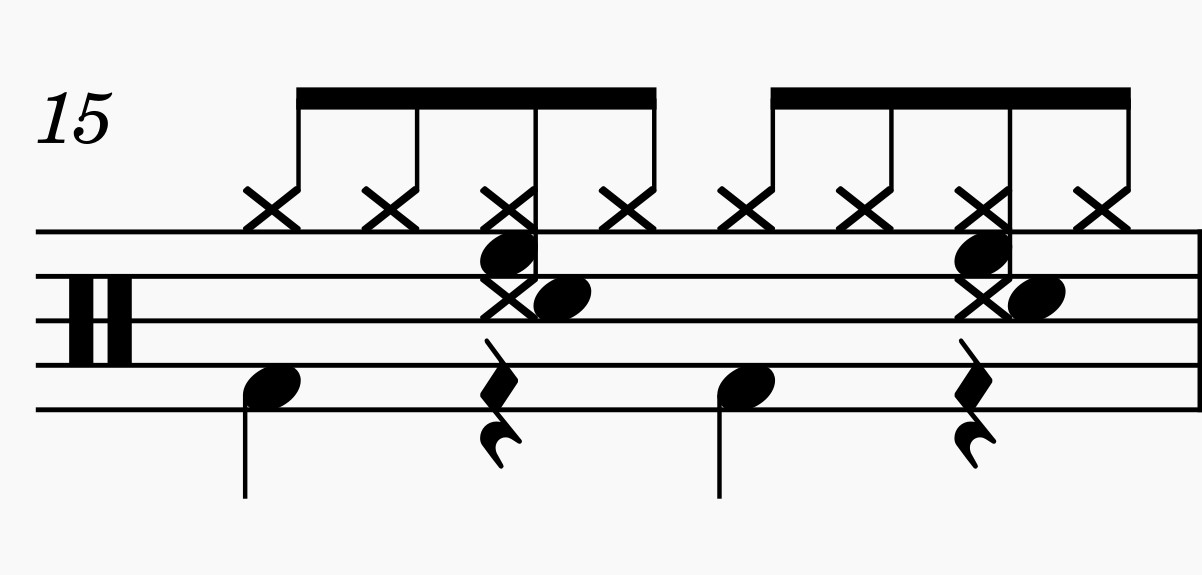
What's wrong with this picture? Part 2
We have another piece of writing I did, which is another instance of an undeniably ridiculous drum set notation. On a streak of poor writing suddenly it seems… While it may be possible to play at an extremely slow tempo, it’s clear that this notation is pushing the boundaries of what is reasonable or practical. But why exactly is it so impossible-looking?
While the bass drum line is still playable, the rest of the notation is a mess. When a snare drum and hi-hat are hit at the same time, it typically requires both hands. However, in this example, we see the snare drum, hi-hat, a high tom, and a cross stick on the snare all being hit simultaneously. Unless someone has four arms, this notation is essentially impossible to play.
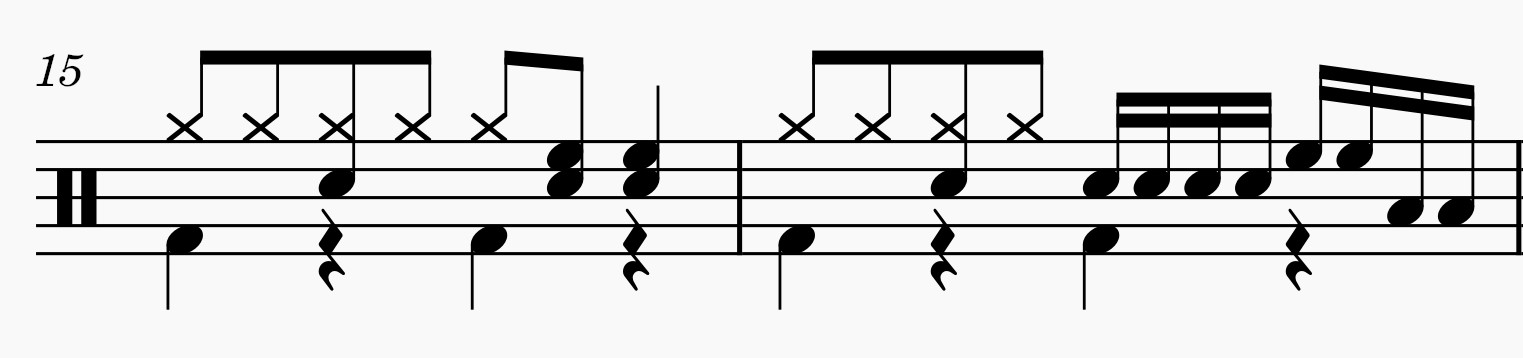
So many possibilities, so sometimes it's best to let them breath!
This fill right above where the snare and high tom hit at the same time is a clean and reasonable lick. It takes into consideration the number of limbs available and what they are currently doing. That’s why the Hi-hat line stops playing to give way for the snare and high tom to be played simultaneously. Even if it were possible to play all of these different things at once, the beauty of less is more allows these voices to speak better. So, in drum set notation, it’s crucial to balance complexity and playability to make sure the music sounds great and is enjoyable to perform.
Knowing some fundamentals will help with creativity.
Writing bad examples was an unusual task to take on, as I discovered that the notation software can be quite finicky and make it challenging to achieve what I want. The first example of poor writing was still technically playable at a very slow tempo, but it was difficult to get it just right. Despite these challenges, I am still learning a lot about using the software, and focusing on the fundamentals is helping me to unlock my creativity.
Conclusion/Preview!
This week’s topic was shorter than usual, but that doesn’t mean it was any less important. It was crucial to discuss the limitations of drum set writing before moving onto more complex grooves. Sometimes it’s important to take a step back, and this week allowed us to do just that. Moving forward, we will delve deeper into the grid system and explore how we can write for the limbs within its context. The goal is to create music that not only sounds great but is also fun and enjoyable to play. It’s important to acknowledge that the grooves and rhythms that we will be exploring in the upcoming weeks will be much more complex than what we have seen so far. However, by establishing a strong foundation in the basics of drum set notation and understanding its limitations, we are better equipped to tackle these complexities. I look forward to seeing you next week!