
Using what we know to create longer pieces of music/Swing
Welcome back!
Welcome to week 7 of our 8 week project! Last week, we really pushed the limits of syncopation and figured out how to influence the snare voice more effectively to create more interesting grooves. It was definitely a lot of grunt work and learning how to use the notation software in this way, but it allowed us to create some really cool drum beats. This week, we’ll be focusing on bigger picture works and showcasing some of the more complex drum beats that we’ve been working on. Additionally, we’ll quickly touch on how swing is written for drum set, as it’s a fundamental concept in jazz and other styles of music.
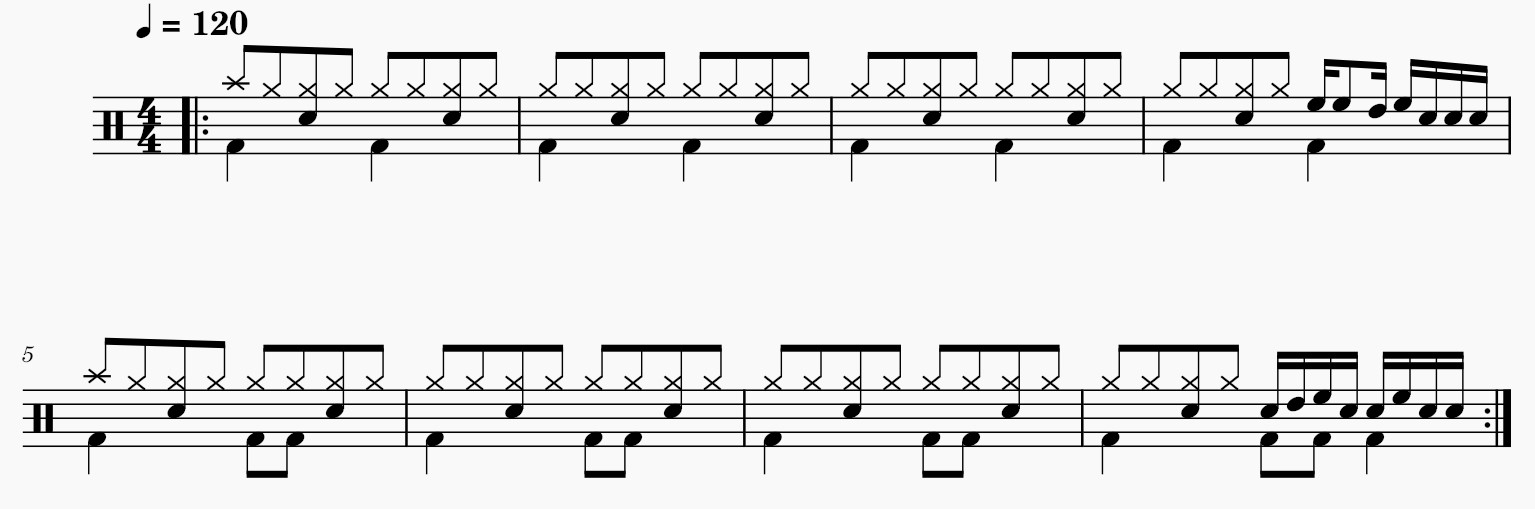
It's all coming together
This simple yet compelling 8 bar phrase I wrote showcases some of what we’ve learned about so far in the project. It’s contextual based for when a drum set will fill at the end of a few bars, though typically it is common for a drum set to fill after four bars and after 8 bars. Knowing the general form of drum set writing is very useful, as the same material can be utilized for a whole song. These 8 bars showcase fills, variation in the bass drum starting line 2, and making sure fills come in back on time. Because of how much fundamental work has been done, doing these bigger phrases is 1000x easier and efficient.
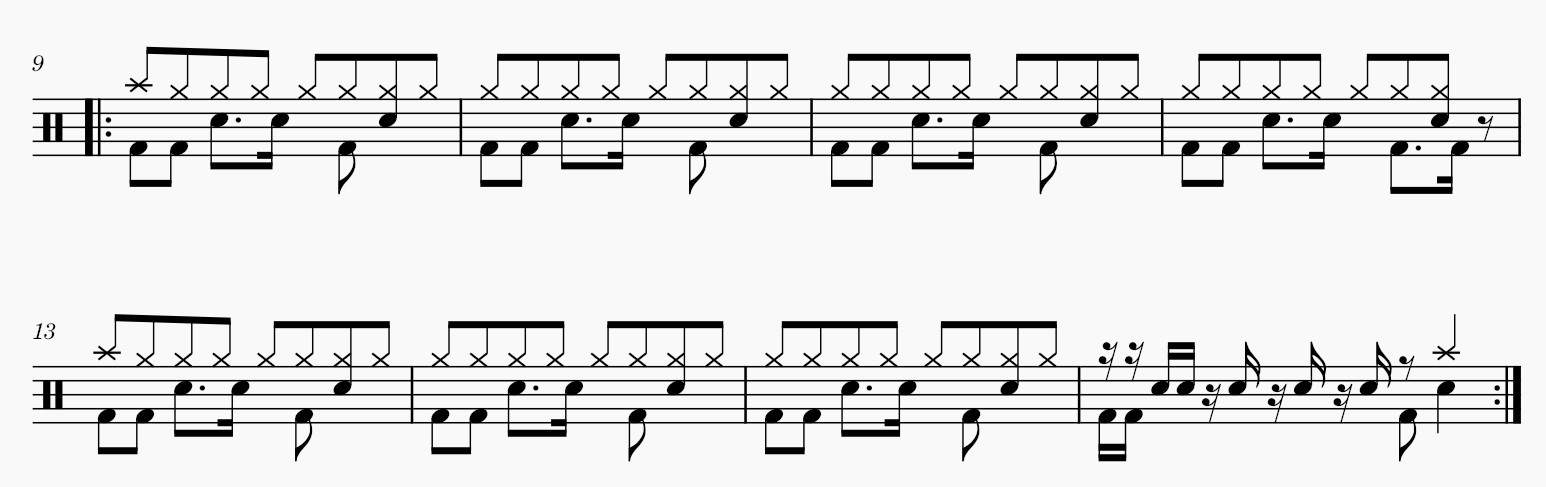
Starting to have some fun
Here we have another 8-bar phrase that’s significantly more complex than the previous one. It incorporates some of the more intricate rhythms I’ve learned to input over the past few weeks while still ensuring it’s still playable. It’s always crucial to keep in mind whether something is realistically playable, particularly when more notes are added to the mix. Nevertheless, it’s incredibly satisfying to be able to use these tools more effectively and quickly create something like this. At the beginning of week 1, I was struggling to figure out how to write efficiently and just get something on the page. However, after numerous hours of experimentation, I’m at a point where I can compose something like this and have fun playing and reading it.
It doesn't seem like it, but we already have almost a full page of written drum set music
Here are the set of 8 bar phrases I wrote, but if combined they now will a create a 16 bar phrase.
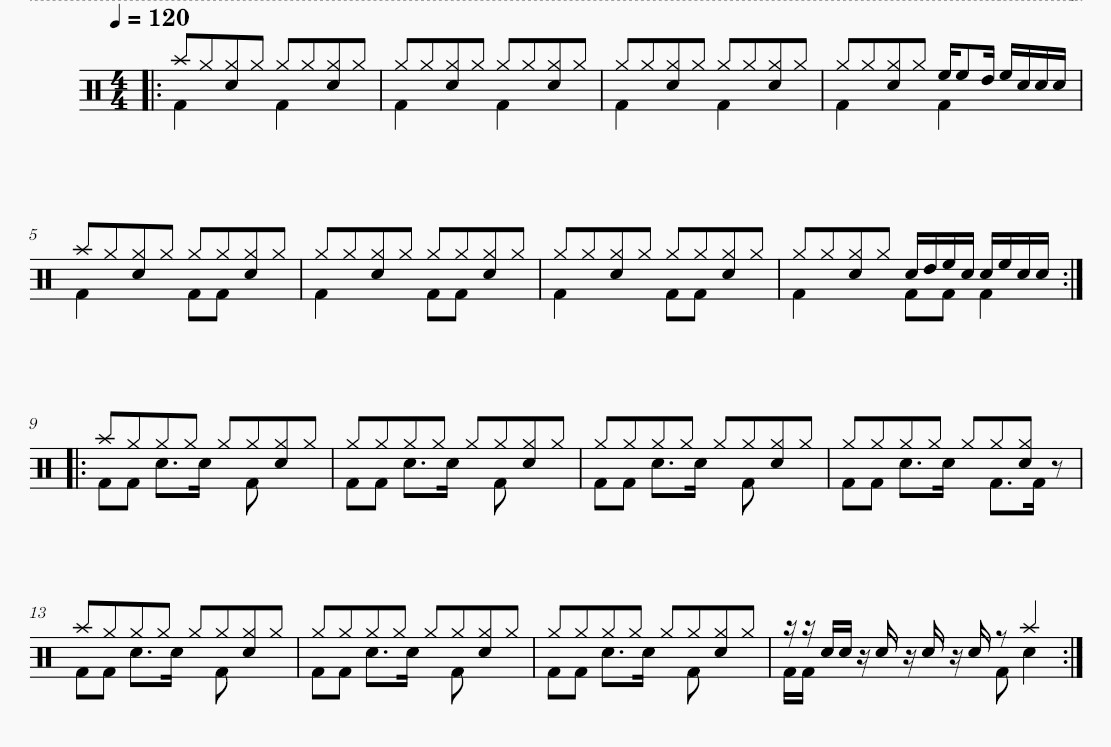
There’s already a lot of music!
Drum set writing can be quite efficient once you realize that so much of it is based on repeated material from the initial groove. It’s amazing how much progress can be made once you have a solid foundation to work off of. Even with just a couple of 8 bar phrases written down, a lot of the material can be repeated for the rest of the song. Of course, you can add flourishes and variations to keep things interesting, but the previous examples are already enough to create a solid groove for a piece of music. This is one of the beauties of drum set writing – the ability to reuse material and create something new and unique from it. So it’s important to keep in mind that while there’s always room for variation and creativity, drum set writing also has a lot of foundational elements that can be repeated and used to create a cohesive groove throughout a song. This not only saves time, but it also helps create a sense of continuity and structure in the music. Of course, there are times when a completely new groove is needed, and that’s where the fundamentals of drum set writing come in handy. By understanding how to create different rhythms and syncopated patterns, it becomes much easier to come up with new material when needed.

Quickly switching gears through writing swing
Just like rock, there are main instruments that are most utilized in writing for it. In rock it was the hi-hat, bass drum and snare drum. These three were the main important aspect to the groove and what the grid was based off of. For swing it’s a bit different, but in some ways simpler. In swing the most important instruments that create the swing feel are just two, and they are all tangy instruments, aka metal instruments, the cymbals!
The ride cymbal is the main instrument in swing that drives the beat forward and creates the swing feel. It is typically played on beats 1, 2, 3, and 4, with a heavier touch on beats 2 and 4 to create the swing feel. The hi-hat is also utilized in swing, but it serves more as an accenting instrument rather than a driving force. Understanding the role of these two cymbals is crucial to writing and playing swing music, and with a solid foundation in drum set writing principles, it becomes easier to create interesting and compelling swing grooves.
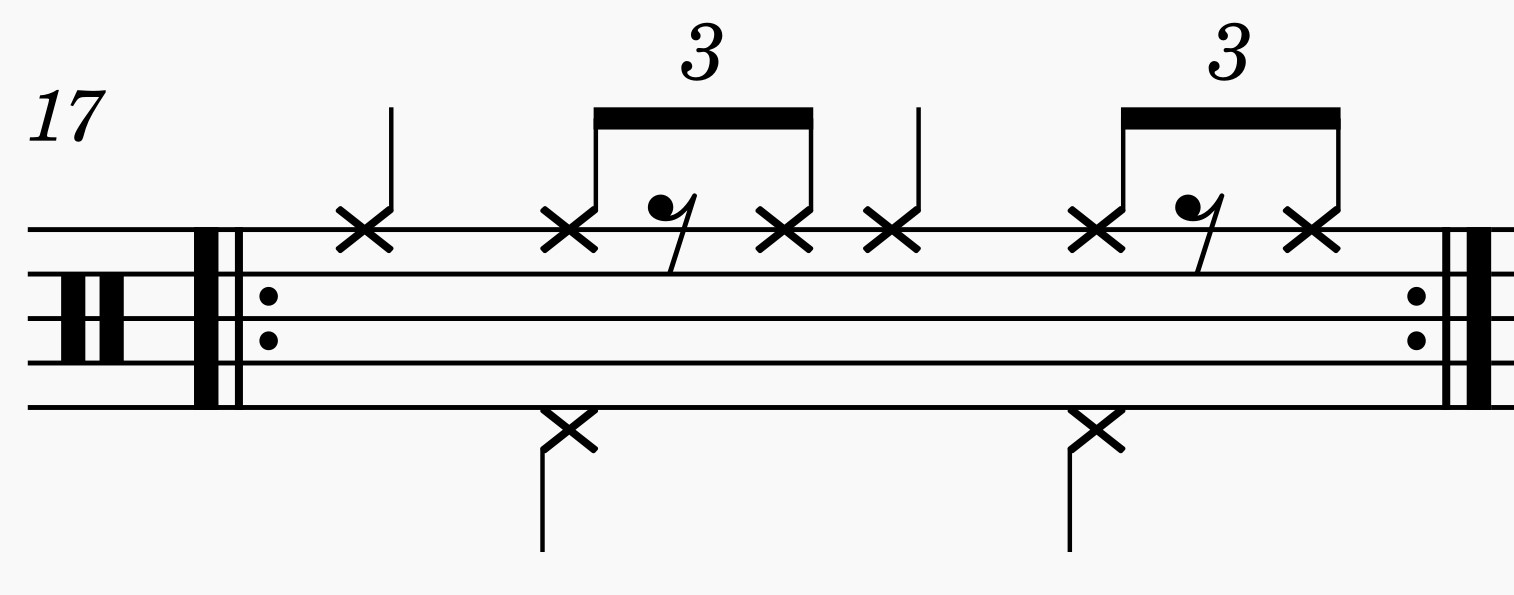
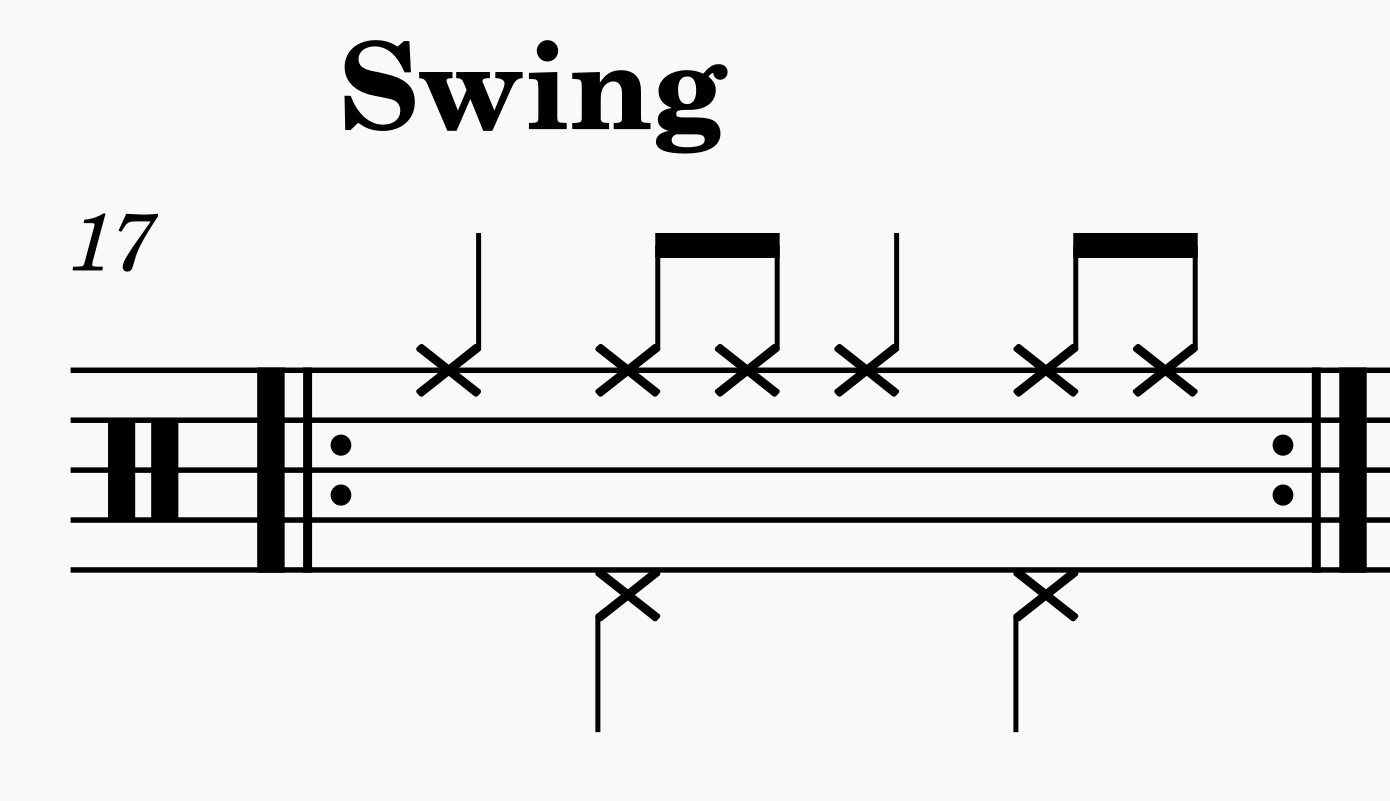
Quickly understand and building the swing pattern
Both of these examples of the swing beat may look different, but they are the same underlying rhythm. The left picture shows what the swing rhythm sounds like when notated in a straight feel with evenly spaced eighth notes. On the other hand, the right picture shows the more common way to notate swing where the eighth notes on beats 2 and 4 are already assumed to be swung. This notation is much easier to read and write, especially for beginners, and is what we’ll be using for most swing notations. However, there are times when the left example may be necessary, such as transcribing a piece that is not entirely swung throughout. It all depends on the specific situation and context.
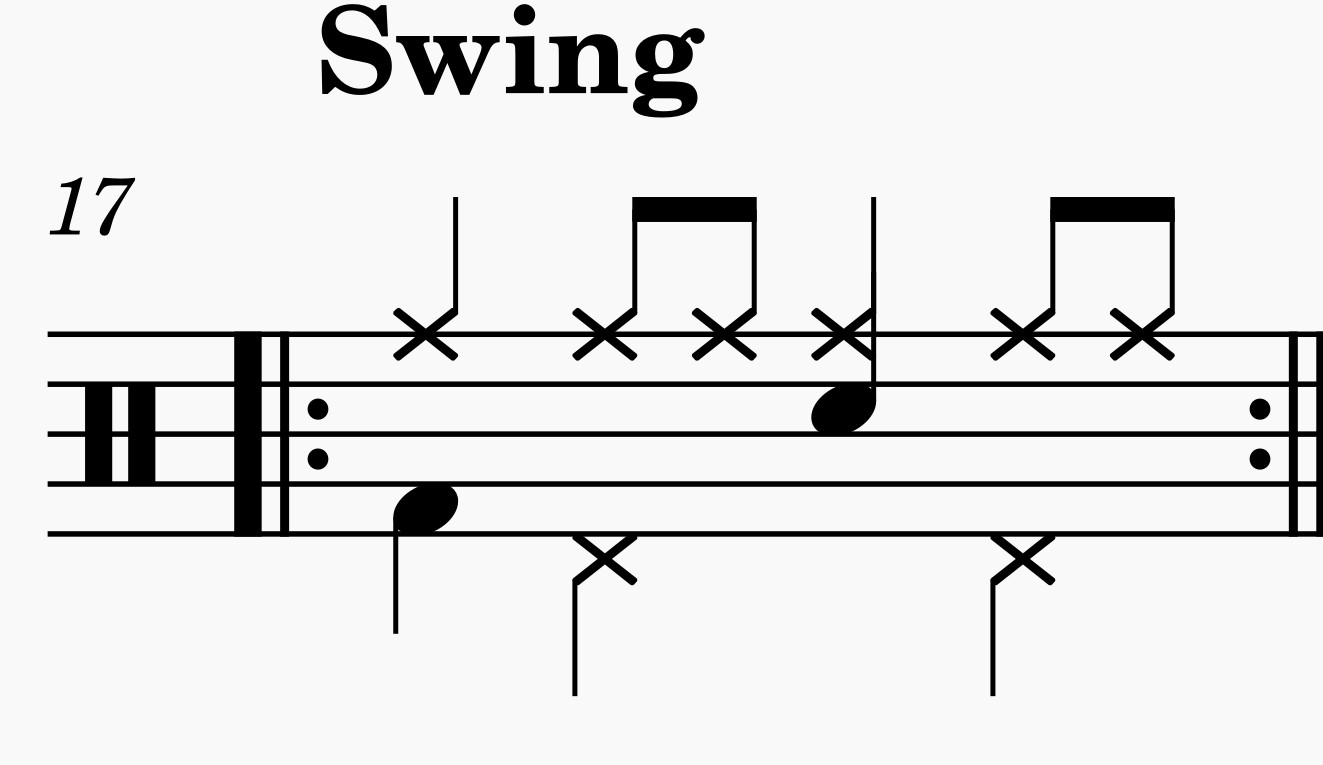
This basic swing pattern may seem simple, but it’s a great starting point for exploring the improvisatory nature of jazz and swing drumming. While the grid system can be used as a foundation for creating different patterns, it’s important to remember that swing and jazz music are heavily based on improvisation. The drummer will often embellish the basic pattern with other instruments on the kit and adapt to the other musicians in the band. When notating swing beats, it’s important to keep in mind that the drummer may deviate from what is written and improvise. This is part of the beauty of the style and should be embraced. By understanding the basics and leaving room for improvisation, the drummer can create a unique and expressive swing feel.
Getting closer to wrapping up
This week’s blog was a blast to put together! I had a lot of fun experimenting with the notation software and exploring more complex techniques for drum set writing. It’s amazing to see how far I’ve come from last week, where I was struggling and feeling frustrated. But this week, I was able to utilize the skills and knowledge that I’ve acquired from the previous weeks and dive right into writing some really enjoyable stuff. This project has been an incredible journey of growth and I’m so proud of the progress I’ve made so far. Can’t wait to see what new challenges and discoveries are in store for the coming weeks!
Conclusion/Preview!
It’s incredible how quickly time has flown by during this project. With everything coming together, it’s a great feeling to be able to touch on different aspects of drum set writing and watch as all the pieces fit together. Writing a swing pattern was a fun experience, and with a solid understanding of the notation software, it felt like so much had opened up. Looking forward, the final project blog post will be a significant one, with a big conclusion to the project and a mass summary of everything covered. I’ll also be putting together a video summary of the project as a whole to provide a big-picture overview. This final update will be in two weeks, and I can’t wait to share everything with you!